Evaluating limits of automation in private equity
My Role : Ideation & Design
Teams Involved : Product & PEC Teams
Timeline & Status : 3 Weeks | Finished


Product Overview & Context
Quick summary


Challenge
Question
Stakeholders proposed valuation automation as a strategic investment.
Before committing engineering resources, we needed to determine whether automation solved the underlying problem or simply addressed a symptom.
Hypothesis
If valuation workflows were automated:
Time spent on reconciliation would decrease
LP confidence would increase
Product differentiation would improve
Research Objective & Approach
Objectives
Validate whether valuation automation solves a meaningful problem
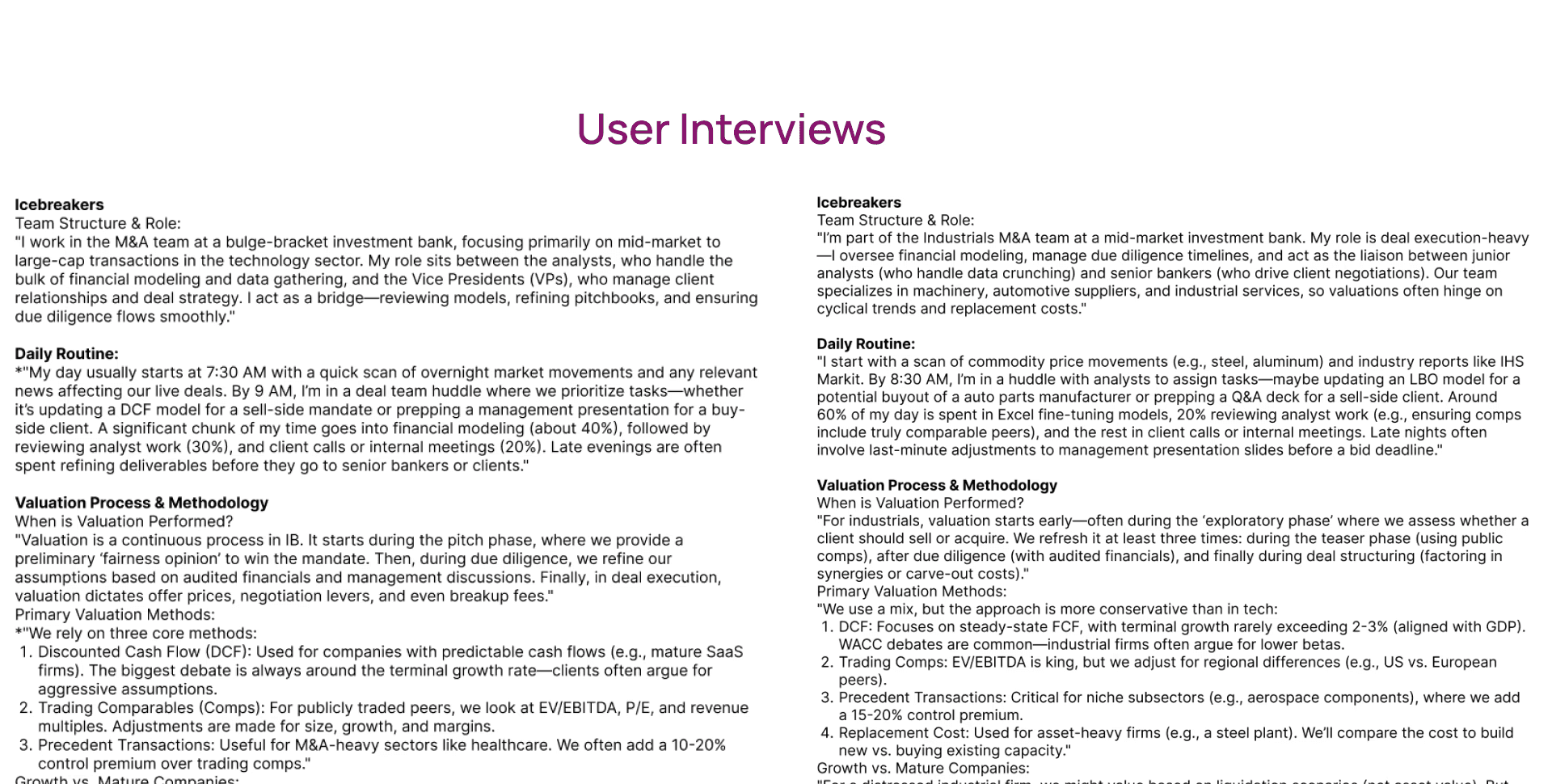
Understand how valuation decisions are made in practice
Identify where software can create the most value
Approach
Industry Research -> Competitive Analysis -> Stakeholder Interviews -> Workflow Shadowing
5 Competitors, 11 Parameters
6 Stakeholders, 3 BUs
5 Shadowing Sessions


Research Findings
Context
Time
Data reconciliation dominates effort. 80% of meeting time is spent validating inputs.
Reasoning
LP scrutiny focuses on assumptions and judgement.
Not calculations.
Valuation automation was never the real problem. It was a proxy for - Trust, Risk Visibility & Perceived Sophistication for stakeholders
Concept Exploration
Solution 01 : Focus on comparable valuation methodology
Aligning technical feasibility, market standards & client asks

Solution 02 : Human-in-the-loop valuation support.
Reduce reconciliation effort while preserving analyst judgement.
Values in table prepopulate but analyst has the affordance to edit & audit it.

Validation Result & Business Impact
$100K+ avoided
In misaligned engineering & product investment
No Automation
Validated a shift from full automation to human in loop intelligence
Other Visual Explorations


Reflection
This study reinforced that while valuation intelligence can add rigour, private equity decision-making remains deeply contextual.
Most valuable role of software in this space is not replacing judgment but - supporting it with timely, trustworthy signals

